

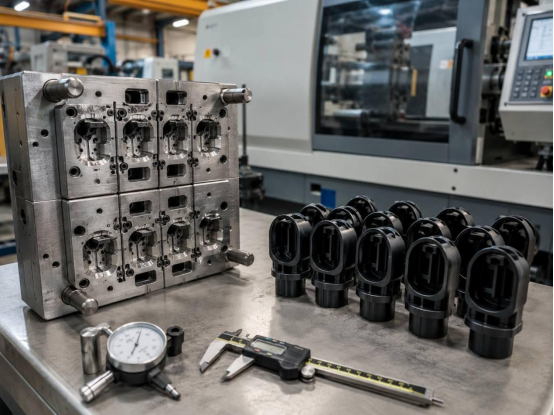
Manufacturing efficiency depends on choosing the right tooling. When a project moves from early samples to full-scale runs, the goal changes. The aim becomes lower cost per piece without loss of quality. A multi-cavity injection mold makes this shift possible. It produces several identical parts in one cycle, so total output grows without extra labor or machine hours. Maidder builds these tools with close control over cycle times and running costs. Brands that want to stay ahead in outdoor gear, medical devices, or consumer electronics need to understand how high-volume injection molding works.
What is a Multi Cavity Injection Mold and Why Does It Matter for Plastic Production?
Defining the multi-cavity mold concept
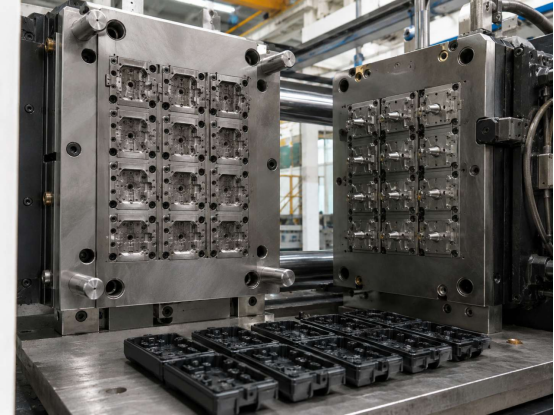
A multi-cavity mold holds two or more identical cavities inside one frame. Single-cavity tools suit low-volume work. Multi-cavity tools focus on speed. Each cycle fills all cavities at the same time, so several parts come out together. This layout supports modern plastic production for items from small gears to appliance housings.
Accelerating production timelines
Speed to market is a critical metric in global manufacturing. Utilizing a multi-cavity injection mold significantly shortens the time required to complete large orders. For instance, a 16-cavity tool can complete a 160,000-unit run in the same number of cycles it would take a single-cavity tool to produce just 10,000 units.
Impact of multi-cavity mold design on throughput
The geometry and layout of a multi-cavity mold design dictate the overall efficiency of the injection molding machine. A compact, well-organized layout minimizes the travel distance of the molten plastic, which in turn reduces material waste in the runner system. Efficient design ensures that high-volume injection molding operations remain profitable by maximizing the number of parts produced per ton of clamping force.
What are the Economic Benefits of Multi Cavity Molds in Plastic Production?
Reducing labor and energy costs per unit
High-volume injection molding is inherently more efficient than other processes like rotomolding for certain applications. By using a multi-cavity injection mold, the energy consumed per part is drastically reduced because the machine's heating and clamping systems are utilized more effectively to produce multiple parts at once.
Case Study: 12 Million units for Glade and RTIC
Maidder has a proven track record of managing massive production volumes. The successful delivery of 12 million products for Glade demonstrates the reliability of their multi-cavity mold design and production management. Furthermore, the collaboration with RTIC on outdoor ice buckets showcases the ability to maintain high-performance insulation and durability standards while scaling up plastic production through advanced injection techniques and PU foam integration.
How to Optimize Multi-Cavity Mold Design for High Volume Injection Molding?
Critical engineering factors in mold design
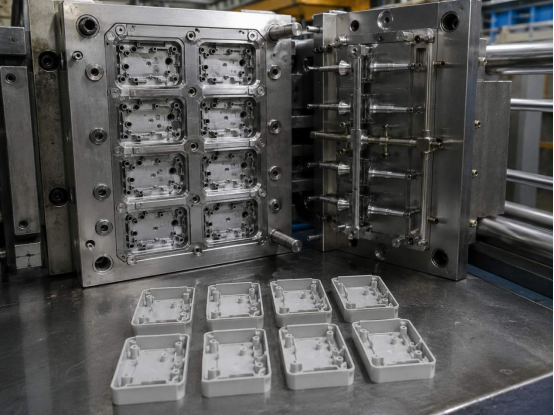
Multi-cavity mold design rests on heat flow and melt movement. Engineers study how each polymer shrinks and where cooling lines should sit. Maidder uses Beijing Jingdiao and Taiwan Gaofeng CNC centers to hold cavity-to-cavity differences inside tight limits. This accuracy matters in technical injection molding. Even a small mismatch can cause fit problems later in assembly.
Achieving mold balance for uniform quality
In high-volume injection molding, every cavity must fill at the same speed, pressure, and temperature. This condition is called mold balance. It comes from equal runner lengths and matched gate sizes. When balance is missing, some cavities over-pack while others stay short. The result shows up as uneven impact strength or surface marks. Maidder hard coolers need steady impact and scratch resistance across every batch, so mold balance receives close attention. Balanced runners are only one part of repeatable multi-cavity production. Gate design, cooling layout, mold steel, machining accuracy, tool fitting, and production validation must also work together. These factors are explored further in Maidder’s overview of precision injection mold accuracy and stability
Role of Moldflow analysis in preventing defects
Before any steel is cut in the Maidder tooling room, a comprehensive Moldflow analysis is performed. This digital simulation identifies potential issues like air traps, weld lines, or areas of excessive shear heat. For complex or high-precision products, this service is provided free of charge to ensure that the final multi-cavity injection mold operates flawlessly from the first shot. By identifying these risks early, the engineering team prevents costly mold modifications and ensures that plastic production remains on schedule.
How to Choose the Right Partner for Your Multi Cavity Injection Mold Project?
Evaluating in-house tooling and testing
A reliable partner must have full control over the manufacturing process. Maidder operates an in-house tooling room, which allows for strict implementation of quality control and on-time delivery. Having the design, manufacturing, and testing facilities under one roof—including CMM, colorimeters, and melt indexers—ensures that the transition from a 3D model to a high-volume injection molding reality is seamless.
Value of DFM reports
Professionalism begins with a Design for Manufacturing (DFM) report. This document, provided by the Maidder engineering team, offers optimization suggestions to reduce costs and avoid defects before production starts. With 20 years of experience, the team can identify structural improvements that enhance the longevity of the multi-cavity mold and ensure it can withstand the rigors of millions of cycles.
The Maidder Advantage: Dual-base manufacturing
Maidder offers a unique "Dongguan R&D + Cambodian production" model. This allows clients to benefit from the high-end engineering expertise in China while leveraging the cost-efficiency of the Cambodia factory for assembly, printing, and packing. This one-stop service covers everything from initial design to final dispatch, making it an ideal solution for global brands seeking a competitive edge in high-volume injection molding.
Conclusion
Mastering high-volume manufacturing requires a delicate balance of speed, precision, and economic strategy. By investing in a high-quality multi-cavity injection mold, brands can achieve the mold balance necessary for consistent part quality while significantly lowering their per-unit costs. Whether the project involves complex electronics or durable outdoor coolers, the integration of advanced multi-cavity mold design and rigorous quality standards like ISO 9001 and PPAP is the only way to ensure long-term success in the global marketplace.
Contact us today to receive a professional quotation and a free DFM consultation for your next large-scale project.
FAQ
Q: Why is mold balance critical for a multi-cavity injection mold?
A: A mold balance is needed to ensure that all cavities in a multiple cavity mold filling process occur in a similar manner in terms of speed and pressure. This guarantees that there are no anomalies such as flashing or a short shot and that all pieces made have consistent qualities.
Q: How does multi cavity mold design affect the cost of plastic production?
A: Although the multi-cavity mold has high initial capital costs, it greatly decreases the expenses associated with manufacturing plastic in the long run. This is because it manufactures multiple units per cycle, thereby reducing labor, machine time, and energy cost per unit.
Q: What quality control measures are used during high-volume plastic production?
A: At Maidder, the quality management process is well established and includes quality standards such as ISO 9001, PPAP, and sophisticated equipment like CMM and optical gauges. This is to make sure that all the parts produced from a multi-cavity mold are in accordance with tolerances.
Q: Does Maidder provide design support for a new multi cavity mold?
A: Maidder offers a full suite of design services, including 3D modeling and free Moldflow analysis for complex projects. Their engineering team provides detailed DFM reports to optimize the multi-cavity mold design for maximum efficiency and defect prevention.
