

Reliable small appliance plastic parts begin with one coordinated decision: the housing geometry, internal electronics, assembly method, material requirements, and plastic tooling strategy must be reviewed together before mold steel is cut. Appliance housing injection molding can deliver repeatable cosmetic and dimensional results at scale, but only when the design controls wall transitions, ribs, bosses, gate locations, cooling behavior, and tolerance stack-up from the start.
In practice, small appliance plastic parts should be treated as a complete product system rather than an isolated molded shell. Maidder can support the path from design, tooling, molding, assembly to production validation while keeping material and performance statements tied to defined project requirements.
Why Small Appliance Housings Need Early Engineering Review
A compact appliance enclosure has to protect internal components, present a clean exterior, and hold every interface in the correct position. A housing can look convincing in a prototype yet create sink marks, visible parting lines, connector misalignment, or assembly stress when it moves into molded production.
Cosmetic Surfaces Also Carry Structural Loads
The same exterior wall that defines the product appearance may support ribs, screw bosses, clips, vents, buttons, or internal brackets. If those features concentrate too much material behind a visible surface, differential cooling can create sink marks or gloss variation; if they are too weak, the housing may flex or lose alignment during assembly.
Electronics and Openings Create a Tolerance Chain
PCB mounts, switches, connectors, display windows, cable exits, and buttons each introduce another dimensional relationship. A small shift at one boss or locating feature can accumulate across the assembly and leave a connector recessed, a button tight, or the upper and lower housing halves uneven.
Material Requirements Must Be Defined Before Selection
Heat exposure, impact, electrical insulation, cleaning chemicals, surface finish, color, and applicable product standards can all influence resin selection. No single plastic is automatically correct for every small appliance, and a generic material name is not enough when grades can differ in processing behavior and performance.
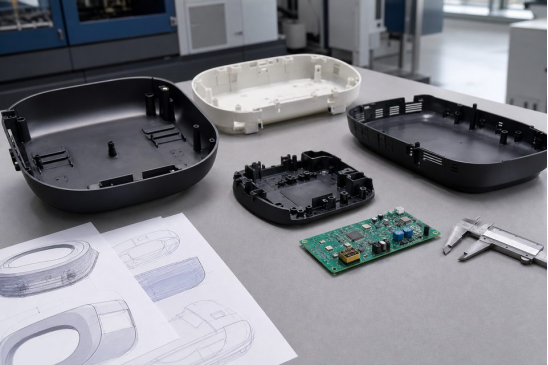
Plastic Housing Design Priorities Before Tooling
Strong plastic housing design connects industrial design with molding and assembly constraints. The most valuable review is completed while geometry can still be changed economically, because late revisions may require welding, machining, replacement inserts, or a new mold component.
Control Wall Transitions and Cooling Behavior
Consistent wall behavior helps molten plastic fill the cavity and cool more predictably. Abrupt thickness changes can increase the risk of sink marks, voids, uneven shrinkage, and warpage, especially around deep features or heavily reinforced mounting areas.
Use Ribs and Bosses as an Integrated Structure
Ribs can stiffen broad housing panels, while bosses locate components and receive screws or other fasteners. Their placement should follow the appliance load path and assembly sequence, with special attention to the exterior surface behind each feature.
Plan Draft, Parting Lines, and Ejection Around Appearance
Every molded housing needs a feasible release direction and a clear strategy for undercuts. Draft, parting lines, shutoffs, sliders, lifters, and ejector locations should be decided with the visible surfaces and assembly interfaces in mind.
Choose the Assembly Method Before Freezing the Housing
Screws support serviceable assembly, snap-fits can reduce loose hardware, and welding can create a more permanent joint. Each route changes the required access, local stiffness, tolerance strategy, assembly equipment, and ability to repair or separate the product.
How Plastic Tooling Decisions Affect Housing Quality
The mold translates approved housing geometry into repeatable parts, so tooling decisions directly influence appearance, dimensional stability, and production efficiency. Tool quality cannot be judged by initial cost alone when gate design, cooling, venting, ejection, and maintenance strategy determine how consistently the housing will run.
Gate Locations Affect Flow and Visible Marks
Gate locations determine where material enters the cavity and how flow fronts meet. Poor placement may contribute to weld lines, air traps, uneven packing, or a gate mark in a sensitive cosmetic or assembly area.
Cooling Strategy Supports Dimensional Stability
Cooling is part of the mold design rather than a later machine setting. Uneven heat removal can make one side of a housing contract differently from the other, which may distort mating edges, openings, or internal mounting locations.
Tool Complexity Should Match Product and Volume
Maidder's capability in plastic tooling allows design, mold construction, and sampling feedback to remain connected. A documented tooling concept, change-control route, maintenance plan, and clear mold-ownership record help keep the project consistent from initial tooling through production.
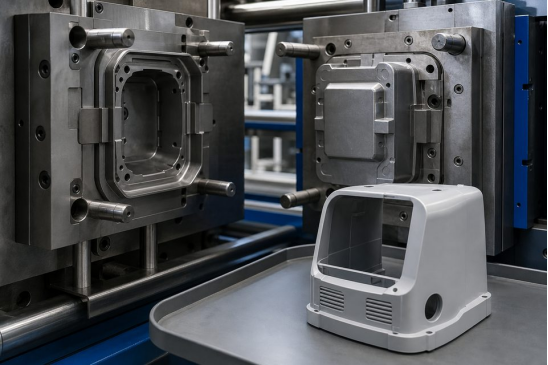
Appliance Housing Injection Molding From Sampling to Validation
Successful appliance housing injection molding is not demonstrated by one attractive sample. Approval should cover the agreed process, dimensional relationships, cosmetic zones, assembly function, and the repeatability needed for the planned production run.
Use DFM and Moldflow Before Steel Cutting
A detailed DFM guide for precision custom injection molds explains how geometry is reviewed for filling, cooling, release, and measurement. Moldflow analysis can add evidence about material flow, air traps, pressure behavior, weld-line risk, and cooling performance, helping the team compare proposed gate and geometry changes before committing to tooling.
Evaluate Sampling as a Product-Build Exercise
Samples should be checked for surface appearance, deformation, critical dimensions, and fit between housing halves. They should also be assembled with representative electronics, buttons, connectors, cables, and fasteners so that the team can see whether the plastic geometry supports the real production sequence.
Confirm Production Readiness, Not Only Part Approval
Production readiness includes the mold, process window, inspection plan, assembly fixtures, work instructions, approved components, and packaging route. This broader review is especially important for injection molded electronics, where a conforming housing can still fail to support consistent final assembly.
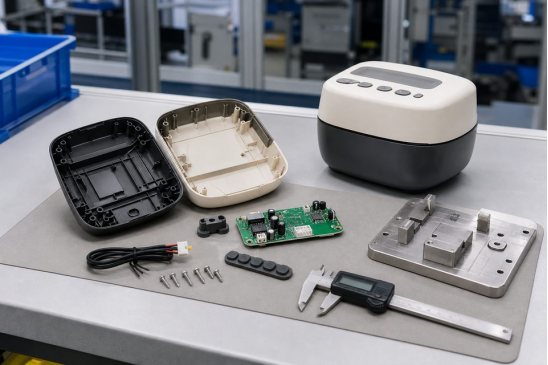
Engineering Checks Before Housing Production
Before housing development begins, the project file should bring together the latest 3D data and drawings, expected annual demand, cosmetic requirements, operating environment, assembly method, critical interfaces, material or regulatory requirements, and intended production location. Unresolved items should remain visible as open engineering decisions so they can be addressed before tooling and validation plans are finalized.
Turn DFM Findings Into Design Decisions
A useful engineering review explains risks in the supplied design and shows how they will be resolved through DFM, Moldflow analysis, tooling, sampling, or validation. Product-specific reasoning is more valuable than broad statements about precision because it connects each concern to a design change, process control, or verification step.
Keep Tooling Revisions Traceable
Tooling records should clarify mold ownership, storage, maintenance, drawing revision, spare or replaceable inserts, approval stages, and responsibility for engineering changes. Clear records protect continuity if the housing evolves after testing or if production planning changes.
Validate What Matters to Product Performance
Critical dimensions, cosmetic limits, assembly checks, material documentation, and production records should be selected according to the appliance and its market requirements. Validation remains most useful when connector fit, joint performance, and visible surface criteria are clearly defined instead of being obscured by documentation that does not address product function.
How Maidder Supports an OEM Appliance Housing Project
Maidder can support design and development, in-house tooling, technical injection molding, CNC machining, and final assembly or sub-assembly. For projects that require a broader production route, its China engineering and tooling resources can be coordinated with scalable manufacturing and assembly capability in Cambodia.
Conclusion
Small appliance plastic parts perform reliably when plastic housing design, electronics packaging, plastic tooling, molding, and assembly are developed as one system. Early DFM and Moldflow analysis reduce avoidable uncertainty, while disciplined sampling and production readiness reviews show whether the housing will support repeatable final assembly.
FAQ
Q: What Information Should an OEM Provide Before Starting Plastic Tooling?
A: Provide the latest 3D model and drawings, expected demand, cosmetic zones, operating environment, assembly method, critical dimensions, material or compliance requirements, and representative internal components. The tooling team also needs to know where the mold will run and whether future design revisions, replaceable inserts, or production transfer should be considered.
Q: How Does Plastic Housing Design Affect Appliance Assembly?
A: Housing geometry locates PCBs, switches, connectors, buttons, cables, and fasteners while controlling how upper and lower shells meet. Poorly planned ribs, bosses, snap-fits, openings, or tolerance stack-up can cause stress, gaps, tight buttons, or rework even when each individual molded dimension appears acceptable.
Q: When Should Moldflow Analysis Be Used for Small Appliance Plastic Parts?
A: Use Moldflow analysis before steel cutting when housing geometry, gate placement, wall transitions, cooling, or cosmetic requirements create meaningful molding risk. It is most valuable when the results drive an engineering decision, such as changing a gate location, redistributing wall thickness, improving venting, or revising the cooling strategy.
Q: What Should Be Validated Before Appliance Housing Injection Molding Is Approved?
A: Validate the agreed resin, appearance criteria, critical dimensions, housing fit, electronic component alignment, joint performance, and assembly sequence using representative parts. Approval should also cover the controlled molding process, inspection plan, drawing revision, tooling status, and production readiness rather than relying on one visually acceptable sample.
