
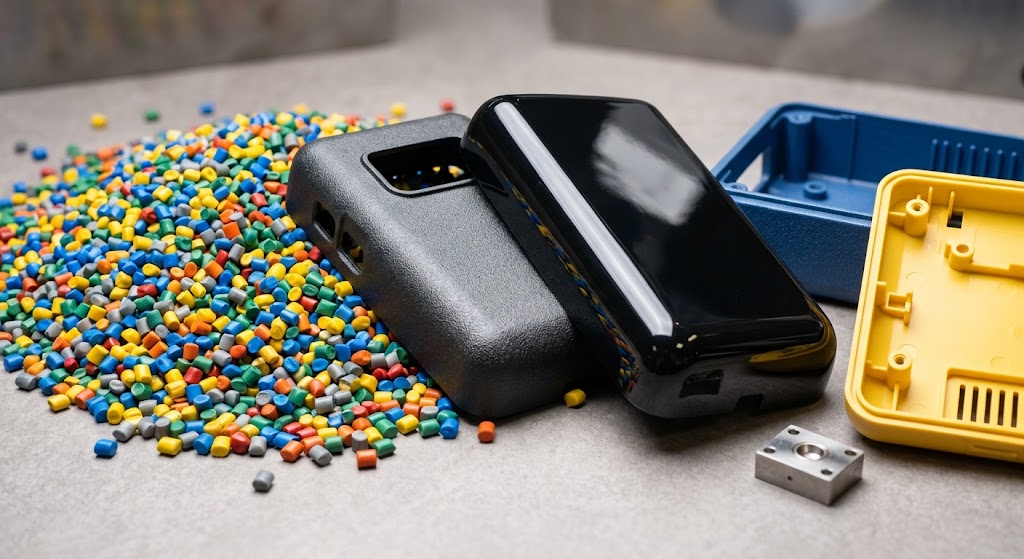
The right plastic injection molding materials are chosen by matching the part's mechanical load, appearance, heat exposure, chemical contact, geometry, and assembly method. Resin selection affects more than strength: it influences shrinkage, warpage, surface feel, weld lines, cycle stability, and whether a housing or functional component fits after molding. Maidder supports material selection as part of a wider design and injection molding workflow.
Begin with the Part's Real Job
A material decision starts with the part, not with a resin name. A protective cover, a snap-fit bracket, a fluid-contact component, and an exterior housing can all be molded, yet they face different loads and different risks. Define what the part must do during assembly and service, then identify the conditions that can change its performance.
For a housing, the brief may include screw-boss strength, impact resistance, dimensional stability, texture, color, and heat from nearby electronics. For an internal component, stiffness, wear, low friction, or chemical resistance may matter more than a premium surface. This practical framing makes plastic material selection for OEM products easier to explain and easier to validate.
How Plastic Injection Molding Materials Affect Performance
Strength, stiffness, and impact
Strength and stiffness are related but not identical. A rigid resin can hold a shape well but may be less forgiving when a part is dropped, clipped into place, or exposed to a sharp local load. Flexible materials can absorb movement, but excessive flexibility may allow a cover to distort or a snap feature to release unexpectedly.
Engineering plastics can extend the design range when a part needs more controlled mechanical behaviour. Filled or blended materials may also be suitable in some applications, but the material choice must remain compatible with the mold design, intended finish, and process window. Maidder lists PC, ABS, PP, TPE, POM, Nylon, filled, and blended materials among its processing options.
Heat and chemical exposure
Temperature changes can alter stiffness, dimensions, and the way two assembled parts fit. A resin that performs well at room temperature may behave differently near a heat source or after repeated heating and cooling. Chemical contact from oils, cleaners, cosmetics, or process fluids should be considered at the same time as temperature, because the combination can be more demanding than either condition alone.
The design team should define the exposure as a real use case rather than a vague requirement such as heat-resistant. Identify the contact substance, duration, cleaning routine, and expected stress. This gives the mold and material teams a clearer basis for choosing among common injection molding materials.
Resin Selection Must Include Mold Behaviour
Material behaviour inside the mold is part of final part quality. Flow length, gate position, wall thickness, cooling balance, and venting influence how the resin fills the cavity and how the part releases. A material may be suitable in principle but difficult to process in a thin, long, heavily ribbed, or cosmetically sensitive geometry.
Shrinkage deserves special attention because the part continues to change as it cools. Differences in wall thickness, fiber orientation, cooling rate, and mold temperature can create dimensional variation or warpage. When asking how material shrinkage affects plastic parts, the useful answer is not a single number; it is a review of geometry, process conditions, and measurement locations together.
Surface finish and visual consistency
Resin selection also shapes the visible character of a part. Gloss, texture, color depth, flow marks, weld lines, and the visibility of minor surface changes depend on both the material and the mold surface. A high-gloss exterior often exposes more variation than a fine texture, so the finish should be chosen with the material and inspection standard in the same conversation.
For products with several visible panels, consistent appearance matters across the complete assembly. Samples should be reviewed under realistic lighting and next to mating parts. Color and texture decisions made before tooling can reduce late changes to gates, cooling, or surface treatment.
Match PP, ABS, PC, and TPE to the Application
PP is often considered when low density, chemical resistance, living hinges, or a degree of flexibility are useful. ABS can suit housings and covers where balanced toughness, rigidity, and appearance are important. PC is commonly considered when impact resistance and dimensional performance are priorities, while TPE is useful when a soft-touch zone, grip, seal, or flexible interface is required.
These are starting points rather than automatic answers. The best resin for injection molded housings depends on wall design, fastening method, heat exposure, surface expectations, and the relationship between the housing and its internal components. A prototype or material sample can reveal feel, fit, and appearance before the final process is fixed.
Connect Material Choice to Assembly
A molded part rarely works alone. It may be screwed, clipped, inserted, overmolded, bonded, or joined through a post-molding process. Material compatibility affects insert retention, weldability, adhesive behaviour, thread durability, and the amount of deformation available during assembly.
Maidder's design service considers strength, durability, appearance, thermal, mechanical, and chemical properties, along with process compatibility. That combination is valuable when a part must move from CAD to a stable injection molding process and then into a repeatable assembly workflow.
For a related example of how material and tooling decisions interact, see Maidder's insert molding process.
Use Prototypes to Reduce Material Risk
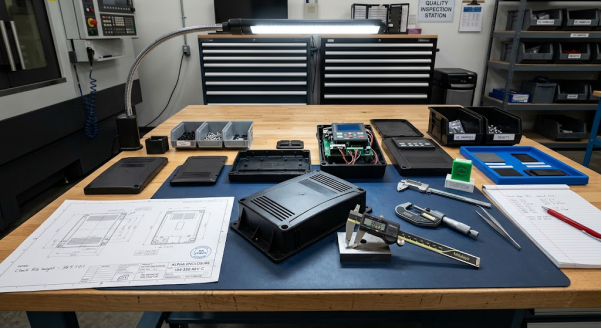
A prototype cannot reproduce every production condition, but it can answer important early questions. Does the part feel too brittle or too flexible? Do clips engage without whitening? Does the surface show the intended texture? Does the selected material work with the expected joining method? These observations can prevent a tooling decision based only on a digital model.
Prototype review should include the complete use scenario: mating parts, fasteners, seals, inserts, packaging contact, and handling. When the part is large or visually important, review several areas rather than approving a single attractive sample. The goal is to connect material behaviour to the part's actual job.
Build Process Control Around the Material
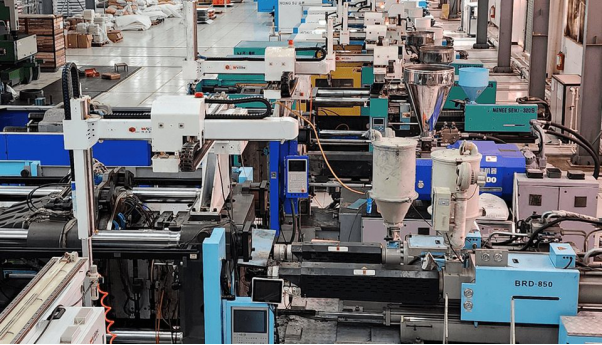
Once the resin is selected, the process needs a controlled way to keep its behaviour consistent. Drying requirements, material handling, color addition, regrind policy, machine settings, cooling, ejection, and inspection all influence the finished part. The production team should know which variables are critical and which changes require a new sample or approval.
Maidder describes support for low-volume through high-volume production, automation, vertical molding for inserts, two-shot molding, and foaming injection. Those capabilities can be considered when the product requires more than a basic single-material cycle, but the final process still needs to be defined around the part, the chosen resin, and the acceptance criteria.
Conclusion
Choosing plastic injection molding materials is an engineering decision that links performance, appearance, shrinkage, tooling, and assembly. Start with the part's real service conditions, compare resin behaviour against the geometry, and use prototypes to confirm feel, fit, and finish.
FAQ
Q: How do I choose plastic injection molding materials for a new part?
A: Start with the part's loads, temperature range, chemical contact, appearance, dimensional requirements, and assembly method. Then compare suitable resins against the geometry and mold process. The prototype test will establish the stiffness, reaction to impacts, surface characteristics, fitting capabilities, and ability to join to other materials.
Q: Which resin is best for injection molded housings?
A: There is no universal best resin for every housing. ABS may suit balanced appearance and toughness, PC may be considered for higher impact demands, PP may help when low density or flexibility matters, and blends or filled materials may address specific needs. The enclosure design and operating conditions determine the final choice.
Q: How does material shrinkage affect plastic parts?
A: Shrinkage may affect size and cause warpage, as well as the relationship between molded parts and purchased ones. Wall thickness, cooling effect, orientation of flow, materials used, and process conditions are some factors that contribute to shrinkage. Review critical dimensions at their functional locations and use mold-flow and prototype feedback where the geometry is sensitive.
Q: Can Maidder help with material selection and molding process planning?
A: Maidder provides material selection support and lists processing options including PC, ABS, PP, TPE, POM, Nylon, filled, and blended materials. Its design and molding services can be considered together when the project needs a practical connection between resin behaviour, part geometry, tooling, production, and assembly.
