

The modern global supply chain is undergoing a strategic transformation. For brand owners and procurement professionals, the focus has shifted from seeking the lowest piece price to ensuring production continuity and supply chain flexibility. A dual-site manufacturing strategy, specifically one that integrates high-end engineering from a China injection molding manufacturer with the scalable capacity of a Cambodia injection molding factory, provides a robust solution for high-growth industries.
Why is a Dual-Site Manufacturing Strategy Indispensable for Modern Global Supply Chains?
The well-known “China + 1” manufacturing strategy has evolved from a theoretical industry concept into a mature, executable operational model in plastic molding manufacturing. Relying solely on one single production base will inevitably bring business suspension risks triggered by regional policy changes, logistics congestion, labor fluctuations and regional trade adjustments. Maidder’s customized China-Cambodia dual-site molding manufacturing mechanism enables seamless handover from complex mold development to standardized bulk mass production. Under this model, professional mold design, precision tooling manufacturing and core engineering debugging are completed in Dongguan, China, laying unified technical standards for all projects, no matter where final molding, assembly and shipment are arranged.
What does this mean for global brands?
· Production continuity is maintained even during regional supply chain disruptions.
· Scalable production becomes achievable without sacrificing technical oversight.
· Global manufacturing support ensures that engineering standards remain consistent across borders.
How does a China Injection Molding Manufacturer Minimize Development Risks?
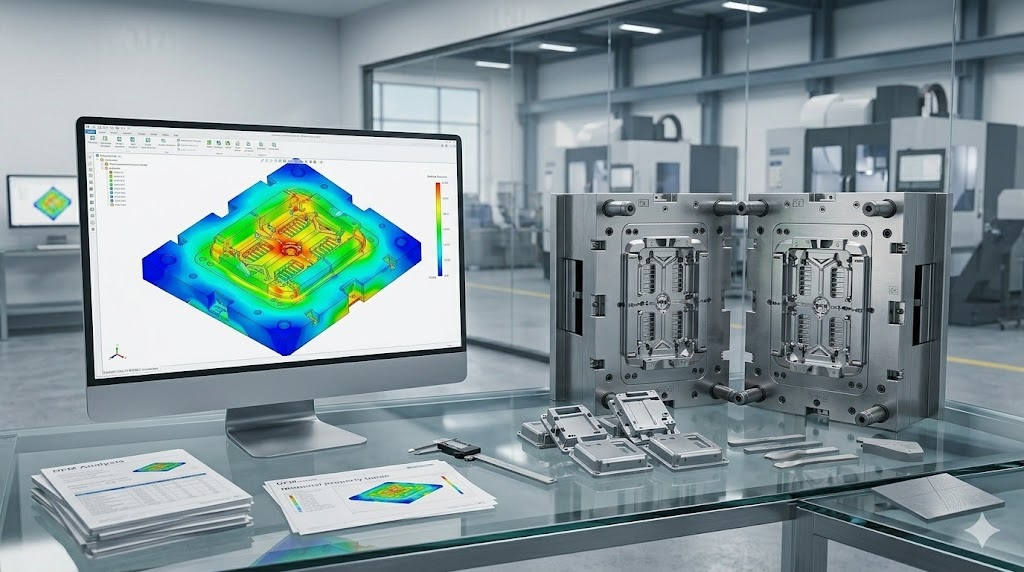
As a seasoned China injection molding manufacturer with over 20 years of precision plastic molding experience, Maidder puts engineering-driven optimization at the core of the entire product development lifecycle. High-precision custom mold tooling is the foundation of qualified plastic parts, while standardized risk prevention work kicks off long before formal mold steel cutting and processing.
What role does Moldflow simulation play in preventing warpage?
Maidder’s in-house engineering team adopts professional Moldflow fluid simulation and structural analysis technology to forecast the flow, cooling and solidification rules of molten plastic inside mold cavities. This data-driven technical method pre-emptively detects hidden production defects including air trapping, asymmetric cooling and uneven plastic filling, which are the leading causes of irreversible part warpage. By iteratively optimizing mold cooling circuits and injection pressure distribution via simulation data, the team ensures finished plastic components comply with ultra-tight dimensional tolerance requirements for industrial and premium consumer applications.
How does optimized gate location improve part consistency?
Correct gate locations are critical for the structural integrity of consumer enclosures and large plastic structures. Improper placement can lead to visible sink marks or weak weld lines. Maidder engineers conduct thorough DFM (Design for Manufacturing) reviews to determine the ideal injection points. This precision ensures that material flow is balanced, resulting in superior surface finishes and consistent mechanical properties across every production batch.
Why is Engineering Leadership Critical for an OEM Partner for Plastic Products?
Selecting a qualified plastic products OEM partner cannot merely depend on production machine scale and factory hardware. Premium outsourcing cooperation requires engineering-led manufacturing capabilities, rather than passive drawing replication. Different from ordinary molding factories that only follow customer drawings, Maidder’s engineering team proactively optimizes original design drafts, fills technical gaps between conceptual design and mass-producible plastic products, and avoids redesign and mold rework costs.
Key benefits of this engineering-led approach include:
· Early identification of localized shrinkage and thickness variations.
· Optimization of material selection to enhance insulation performance.
· Structural reinforcement of large components to prevent bending under load.
How did Maidder Solve Precision Challenges in Premium Storage Systems?
A recent project involving a customer with a series of premium storage systems highlights the power of this integrated approach. The client required large molded housings that demanded both aesthetic perfection and rigorous dimensional control for consistent assembly performance.
During the initial DFM stage, Maidder identified several risks, including uneven wall thickness and potential sink marks. A comprehensive Moldflow simulation was conducted to evaluate gate performance and cooling efficiency. Based on these insights, the engineering team adjusted the wall thickness distribution and optimized the gate locations before mold manufacturing began.
By addressing these challenges in the design phase, the transfer to tool development was significantly eased and had much less risk of later modification. Production validation was very successful with tight tolerance control and no trial and error activity, providing cost value to the client.
What makes a Cambodian injection molding factory the best choice for mass production?
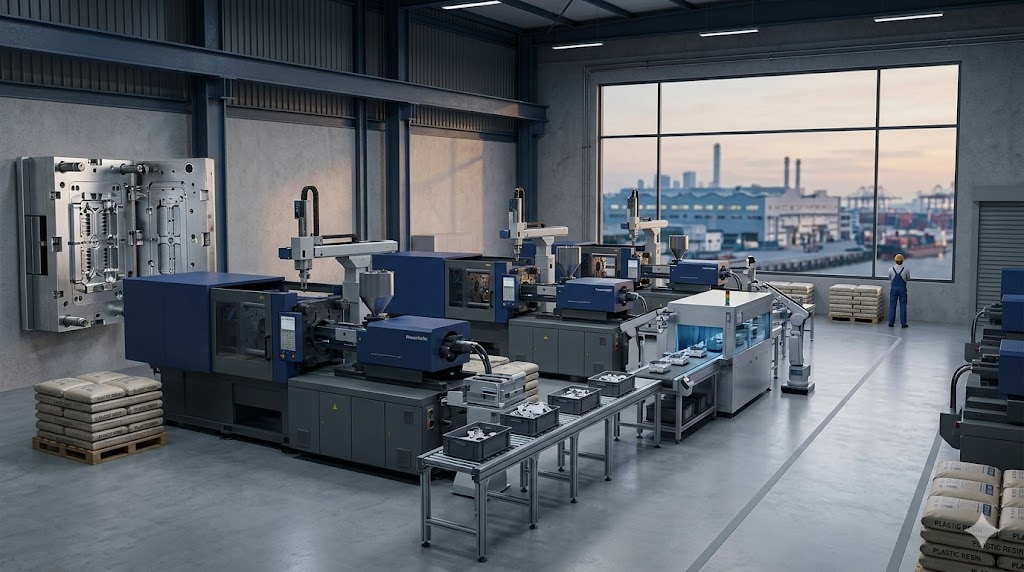
Once product design is finalized, custom molds are polished and validated in Maidder’s Dongguan China facility, mature projects can be transferred to Maidder’s Cambodia injection molding factory for cost-efficient high-volume mass production. The Cambodia manufacturing base is specially configured for bulk orders of pet hardware accessories, consumer plastic electronic housings, oversized industrial plastic structures and household molded plastic goods, with favorable tariff policies and low comprehensive production costs for cross-border shipments to North America and Europe.
How do 2K molding and ultrasonic welding enhance PET hardware durability?
For specialized products like pet hardware, durability and safety are paramount. The Cambodian facility utilizes 2K (two-shot) injection molding to combine different materials, such as hard plastics with soft-touch elastomers, in a single process. This eliminates the need for secondary adhesive operations. Furthermore, ultrasonic welding is employed to create permanent, high-strength bonds for complex assemblies. These advanced techniques ensure that the final products are robust enough for demanding environments.
What capabilities support large-scale industrial projects in Cambodia?
The facility supports a wide range of manufacturing processes beyond standard injection molding, including:
· Blow molding for hollow structures.
· Roto molding for exceptionally large or complex shapes.
· Foaming processes to enhance insulation performance and reduce weight.
· Full-service assembly and sub-assembly for complex consumer electronics.
What is the Value of a Structured Validation Process in Quality Assurance?
Reliability in manufacturing is built upon a foundation of rigorous testing. Maidder has moved beyond rigid, industry-specific frameworks like PPAP to implement a more versatile Structured Validation Process. This system is tailored for high-end consumer goods and industrial products, ensuring every requirement is met before mass production begins.
The validation framework includes:
· Dimensional Verification: Using Coordinate Measuring Machines (CMM) and optical measuring instruments to confirm every part matches the CAD data.
· Risk Assessment: Constant monitoring of process parameters to identify and mitigate potential scrap rates.
· Production Readiness Review: Ensuring that all jigs, fixtures, and assembly lines are fully optimized for the final production run.
Conclusion
The synergy between Maidder’s Dongguan R&D center and the Cambodian mass production base offers a unique competitive advantage. By combining the precision of a China injection molding manufacturer with the scalability of a Cambodia injection molding factory, brands can achieve superior product quality while maintaining supply chain flexibility. From initial DFM and Moldflow simulation to 2K molding and final assembly, Maidder provides the Global manufacturing support necessary to turn complex plastic concepts into market-ready realities. Partnering with an experienced OEM partner for plastic products like Maidder ensures that your project is guided by engineering excellence and production continuity.
FAQ
Q: How does an OEM partner for plastic products like Maidder reduce development risks?
A: Maidder utilizes an engineering-led approach, starting with a comprehensive DFM report and Moldflow simulation. This identifies potential issues like sink marks or warpage before tooling begins, ensuring a smoother transition to mass production and reducing the need for costly trial-and-error modifications.
Q: What are the advantages of using a China injection molding manufacturer for the tooling phase?
A: A China injection molding manufacturer like Maidder offers access to 20+ years of engineering expertise and high-precision equipment such as CNC, EDM, and CMM. This ensures that the molds are built to tight tolerances, which is essential for the success of complex projects like consumer enclosures and premium storage systems.
Q: Why should a brand choose a Cambodian injection molding factory for high-volume production?
A: A Cambodian injection molding factory provides excellent production scalability and supply chain flexibility. It allows brands to diversify their manufacturing locations while maintaining access to advanced processes like 2K molding, blow molding, and ultrasonic welding for products such as pet hardware and large plastic structures.
Q: What kind of Global manufacturing support can I expect from Maidder?
A: Maidder provides seamless Global manufacturing support by coordinating between its China R&D center and Cambodian production base. This includes one-on-one project engineering, 24-hour technical response, and a structured validation process to ensure quality consistency regardless of the production site.
Q: Does Maidder provide quality assurance for complex plastic assemblies?
A: Yes, Maidder implements a rigorous Structured Validation Process, including dimensional verification and risk assessment. Whether it is 2K molding for consumer electronics or large-scale foaming for insulation performance, every step is monitored to minimize scrap rates and ensure the final assembly meets the highest standards.
